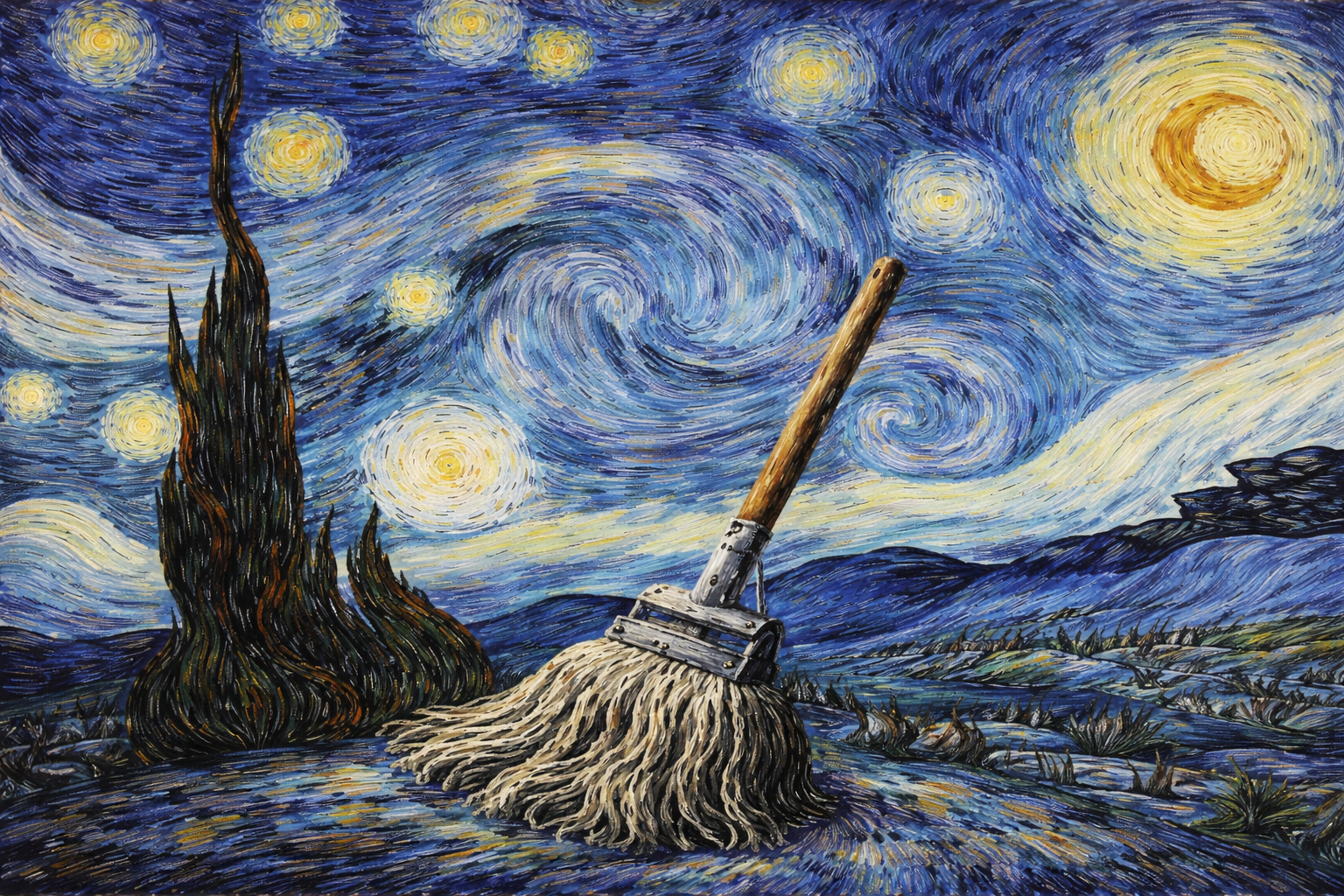
Imagine Van Gogh standing in a room with a mop because the room needs cleaning. Not a brush. A mop.
He'd do it, and I bet he’d do it well. That’s the point.
Misused genius rarely looks like failure. It looks like competence aimed downward.
The floor shines. The canvas stays blank.
Misallocation Doesn’t Feel Like Tragedy
We romanticize wasted talent as the obvious kind: the artist who never makes anything, or the scientist who never gets discovered.
But the most common version of wasted talent is a person with real talent spending their best hours on maintenance or menial tasks.
Wasted talent is when a creative mind is turned into an emotional shock absorber, a strategic thinker turned into a stabilizer, or a perceptive person turned into a translator.
They’re praised. They’re trusted. They’re exhausted in a way no one can diagnose because nothing is “wrong.”
No Assignment is Necessary. Picking Up the Mop Is Easier.
My version of picking up the mop isn't art. It's orientation.
I’m good at reading a room fast—tone shifts, unspoken friction, where the misunderstanding is about to land. I can walk into a room and automatically start adjusting: smoothing, translating, preempting.
Some people call it emotional intelligence. I call it baggage regulation. Yes, regulating other people’s baggage even though it's not my business.
In essence, it's conflict prevention dressed as usefulness—a skill I learned before I started school at age seven, when my grandparents stopped talking to each other directly and used me as a vessel of communication.
It didn’t take me long to realize I could soften their messages to reduce the tension in the air. So if my grandma said, “Tell your grandfather that dinner is ready,” I’d pass on: “Grandpa, dinner is ready. Grandma cooked your favorite meal.”
It worked. People felt comfortable. Things ran smoothly. And slowly, I got the job of regulating the room—the household, the classroom, the company dynamics. All of that has one thing in common: it costs energy.
That’s the trap: if you’re competent, you’ll always find a mess worth cleaning.
Why the Mop Feels Safer Than the Brush
Maintenance gives you three things creation refuses to guarantee:
1. Measurability—the floor is either clean or not.
2. Approval—people reward what keeps the system comfortable.
3. Low exposure—no one judges your soul for mopping.
Creation is the opposite. It’s ambiguous. It asks for taste. It risks being misunderstood. It demands you show your judgment in public, not just your diligence in private.
So the mind makes a trade that sounds mature: I’ll do the useful thing.
Sometimes that’s integrity. Often it’s actually avoidance of discomfort.
The Career Version of the Same Mistake
Organizations love high-competence people because they reduce chaos. So they keep feeding them chaos. The strongest person becomes the permanent stabilizer of dysfunction. The one with the clearest vision ends up formatting slides for someone else’s vision.
Things move forward short-term, but nothing evolves long-term.
The Diagnostic: Are You Overqualified for Your Week?
Here’s a litmus test: open your calendar.
· Where is the work that might fail publicly?
· Where is the work that forces you to operate at the edge of your ability?
· Where is the work that creates a body of evidence of what you can actually do?
If your week is full but none of it requires your highest range, you’re not busy—you’re under-placed.
If you’re under-placed, you don’t crash—you calcify. You keep functioning. You keep helping. And over time, you start to resent how much of your real capacity you’ve traded for being useful.
The floor remains spotless. But Van Gogh withers.
The Correction Is Structural, Not Inspirational
This isn’t a call to quit your job and move to the south of France to become the next Van Gogh.
It’s a reallocation call:
Make. Don’t maintain.
If you’re leading, don’t reward your best people by feeding them smaller and smaller problems just because they can solve them cleanly. That isn’t leverage. That’s waste management.
If you’re holding the mop, be honest about why. Sometimes it’s service. Sometimes it’s avoidance dressed as virtue.
The floor will always need cleaning. But canvases will never get painted by people who are proud of how spotless the tiles are.
And if this felt uncomfortably accurate, send it to a creative friend who’s been mopping floors with a paintbrush in their hand.