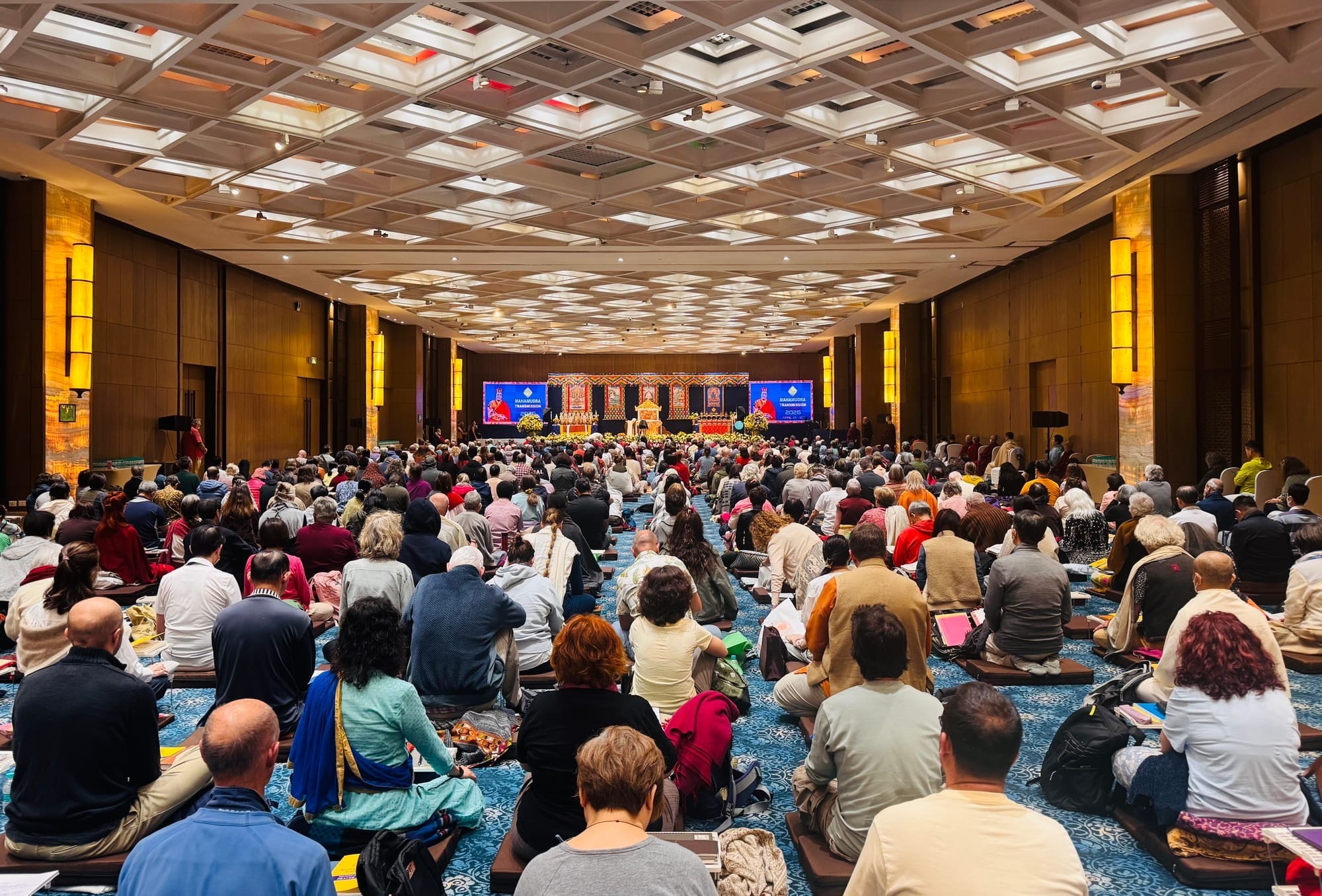
I’ve been in Delhi for a week now, attending a course with the 12th Tai Situpa—a Tibetan teacher whose warmth, joy, and peace put a soft smile on hundreds of faces at once.
It is a strange and rather lovely contrast here: five-star hotel comfort on one side, ancient teachings on mind on the other. The schedule alternates between teachings, practice sessions, and tea breaks. And I’m surrounded by highly respected teachers, monks and nuns, and practitioners who have done three- to five-year solitary retreats. So even after fifteen years of practice, I’m still a novice here.
That said, I’m deeply grateful for the immense benefits meditation has brought me over the years. It has made me more emotionally stable, more peaceful and content, and better able to connect with others. That’s why I wanted to share my two cents.
If you’ve considered meditation, or tried it and got frustrated, and concluded that you simply can’t meditate, this article is for you.
Just as a disclaimer, I’m not an expert on meditation promising to help you transcend your thoughts by Thursday. I’m still learning how to sit with my mind. I’m just curious—and stubborn—enough to keep returning to the never-ending task of understanding the patterns in my thinking, my belief systems, and the emotional reflexes that shape how I move through life.
The first mistake
A lot of people seem to imagine meditation as sitting cross-legged with a blissful smile, in a sort of scented-candle advertisement for inner peace. The mind is supposed to go silent. The face is supposed to look enlightened. Preferably by minute seven.
Then they sit down, and what they get instead is shopping lists, old arguments, fantasies, songs from 2004, a vague itch on the nose, and the sudden need to reorganize their whole life immediately.
And they think: I’m failing.
I made that mistake too. So I asked one of my teachers, Lama Yeshe Rinpoche, the former abbot of Samye Ling Monastery, how to stop thinking in order to meditate. He said something that changed my perspective completely:
“Do you try to stop your ears from hearing? Do you try to stop your eyes from seeing? So why do you try to stop your mind from thinking? Let the mind do its job.”
That was the first real correction. I realized that thoughts are not proof that meditation is failing; they are proof that the mind is alive.
Ringu Tulku Rinpoche, one of the teachers who most shaped my understanding of meditation, once compared the mind to the sun.
“Mind is like the sun. The sun radiates heat and light. In the same way, thinking, sensing, imagining, and remembering are the activities of the mind.”
So the task is not to force the mind into silence. The task is to watch thoughts arise, linger, and pass.
Waterfall mind, river mind, lake mind
Many teachers say that the mind looks like a waterfall in the beginning. One thought crashing into another. Fast, loud, crowded, forceful. You sit down for five minutes and discover you have apparently been running a 24-hour news channel with no standards, and every thought is apparently urgent.
With time, the mind may become more like a river. Still moving, but less violent. More continuity, less collision.
And sometimes, it can feel like a lake with shimmers on the surface. Not completely still, just calm and alive.
I remember walking on Holy Island in Scotland during retreat with Lama Yeshe Rinpoche. The sea was calm that day, almost like a lake, with light moving across the surface. He pointed to it and said, “This is the shimmering mind.” That image stayed with me because it corrected yet another misunderstanding.
The goal is not to turn the waterfall into a lake. The task is to observe the mind in whatever form it has taken today.
No judgment, internal scolding, or secret performance review after each sitting is necessary. A waterfall is not a moral failure. A lake is not a personal achievement badge. These are conditions, not identity.
They are not linear either. One day, the mind may be spacious and quiet. The next day, it may behave like a cupboard falling down a staircase. Neither day defines you. Neither day tells you what the rest of your life will look like.
Meditation becomes much kinder when you stop treating each sitting like a referendum on your spiritual worth.
The mental gym
I understand discipline through the body. I’ve always been drawn to sports, to repetition, to turning up whether I feel like it or not. Meditation began to make more sense to me when I stopped treating it like a mystical event and started treating it like training.
People think meditation works through intensity. Actually, it works far better through consistency.
This is where many beginners sabotage themselves. They decide they will now become a person who meditates for forty-five minutes every morning. They buy a cushion that looks like professional equipment, and enter a new era of existence.
Three days later, they’re gone.
Meditation rewards regularity, not heroics.
Yongey Mingyur Rinpoche, the guiding teacher of the Tergar Meditation Community, has emphasized that short, regular practice is better than waiting for the perfect long session. He also says that even a short daily sitting is better than postponing meditation until you “have more time.”
That makes intuitive sense to me. If fifteen minutes feels like a burden, do ten. If ten feels like a burden, do five. Leave the session with enough appetite to return, instead of using willpower to drag yourself across the line and then avoiding it for a week.
The Western mind, or at least mine, loves to convert everything into a linear task: complete it, optimize it, tick the box, move on. But meditation is not the kind of thing you finish.
There is no graduation from brushing your teeth. No last nourishing meal after which you are permanently handled. No triumphant night of sleep after which you never need sleep again. Meditation belongs in this category.
It is not a conquest but a form of maintenance. It is better understood as an ongoing, long-term relationship. You do not win it. You keep company with it.
John Yates, the author of The Mind Illuminated, put it plainly in his book:
“The only ‘bad’ meditation is one you didn’t do.”
So, a distracted meditation still counts.
A restless meditation still counts.
A dull meditation still counts.
A five-minute meditation absolutely counts.
The mind was met. That’s what matters.
You don’t need a perfect setup to begin either. A chair is fine. Five minutes is fine. A reasonably quiet corner is fine. The point is to start.
Training attention
At the beginning, meditation is simply attention training.
There are many methods. You can count the breath. Use a guided practice. Rest attention on sound. Rest it on the body. Use an object. Use a mantra.
And yes, guided meditation is still meditation. If it helps you train attention and stay present, it is a perfectly valid doorway into practice.
But the doorway is not the destination.
Most people think they are choosing between different kinds of meditation. Actually, they are often choosing between different pieces of equipment for training attention.
At the gym, you may use a treadmill, kettlebell, cable machine, dumbbell, or rower. The equipment changes. The body is still being trained.
Meditation is similar. The tools vary. Attention is what gets strengthened. This also explains why meditation can feel tedious.
Meditation is repetitive. So is every form of training worth anything.
No one is shocked that playing the piano may require months or years of training, depending on how well you want to play it. No one is offended that having an amazing beach body requires a lot of time at the gym each week, on an ongoing basis. But somehow we expect to calm the mind after three brief sits on a round cushion.
What we train, we strengthen. And the mind is no different; attention grows through repetition more than intensity.
The badly behaved child
One analogy I’ve always liked is that the mind is a very undisciplined child. It runs around the house, draws on the walls, spills things, opens cupboards, changes activities every nine seconds, and creates an atmosphere of minor domestic vandalism.
If you run after a child like that, you’ll be exhausted. The child has more energy for chaos than you have for control.
But if you sit still, stay present, and stop feeding the frenzy with more frenzy, eventually the child tires out. It may even fall asleep by your knee.
The mind is often like that.
When we chase every thought, argue with every feeling, and react to every internal movement as if it were an emergency, we strengthen the drama. When we sit still and observe, the mind often settles of its own accord.
The point is not to dominate the mind, but to stop joining its commotion.
A great deal of what we call mental chaos is kept alive by our own constant interference. Sometimes the deepest shift begins when we finally stop chasing and let the mind learn how to settle in our presence.
When meditation turns into sleep
When we first start relaxing properly, we may get sleepy. We sit down to meditate and within minutes we are drifting off like pensioners in an armchair after lunch. And we think: excellent, I have failed again.
One of my teachers, Tai Situ Rinpoche, often says that if people fall asleep in meditation, he is happy, because it means they have genuinely begun to relax. Of course, meditation is not meant to become a long-term nap strategy. But at the beginning, sleepiness can simply show that the system has been running under strain for a long time and is finally letting go.
The first shape of calm is rest.
There is a pendulum quality to habits. When we let go of one extreme, we often swing toward the other end before finding the middle. Someone used to chronic agitation may, at first, swing toward hmental fog or sleep. That is not the final destination; it is just part of the rebalancing.
The point is not to be impressed or alarmed by every phase. The point is to keep practicing long enough for a steadier center to emerge.
A simpler definition
After all these years, my definition of meditation has become much simpler.
Meditation is not the suppression of thought.
It is not instant bliss.
It is not a personality upgrade.
It is not looking peaceful from the outside.
Meditation is the repeated act of meeting the mind as it is, and training attention to stay where we want it to stay.
If you still think you “can’t meditate,” I would simply ask: could it be that you’ve been expecting the wrong outcome?
Ten Ways to Start Meditation Without Drama
- Drop the idea that meditation means no thoughts.
If thoughts appear, that does not mean you’re doing it wrong. It means you have a functioning mind. - Start with five minutes, not ambition.
A short practice you actually repeat is worth more than a grand plan. - Practice often, not heroically.
Consistency trains the mind better than occasional intense sessions. - Pick one simple anchor.
Breath, sound, body, or a guided meditation. You do not need a sophisticated method to begin. - Treat thoughts like buses that arrive at a bus stop.
Your task is to remain at the bus stop. Notice different buses arrive, with different colors, different passangers, different temptations. Do not get on any; just remain at the bus stop. If you find yourself riding on a bus that you don’t remember when you get on, get off immediately and return to the bus stop. - Don’t grade the sitting.
Waterfall, river, lake…just observe the condition. Today’s shape is not permanent reality. - Return attention gently, but repeatedly.
The return is the training. Getting lost in thought, noticing it, and returning is not an interruption of the practice. It is the practice. - Expect restlessness before steadiness.
A mind that has been running for years does not suddenly sit still because you bought a cushion. - If you get sleepy, adjust without self-scolding.
Sit a little straighter, look upwards, shorten the session. Sleepiness is a part of the pendulum swing, not proof of incompetence. - Think of meditation as mental hygiene, not transcendence.
Imagine all the things you do for your body—sleep, movement, and decent food—meditation is a way of taking care of your mental and emotional wellbeing. And it works best when it becomes part of ordinary life.
For most beginners, the problem is not meditation. It is the expectation they bring to it. Meditation becomes much less intimidating once you stop treating thought as a mistake. The mind does what minds do. The practice is to meet it there.